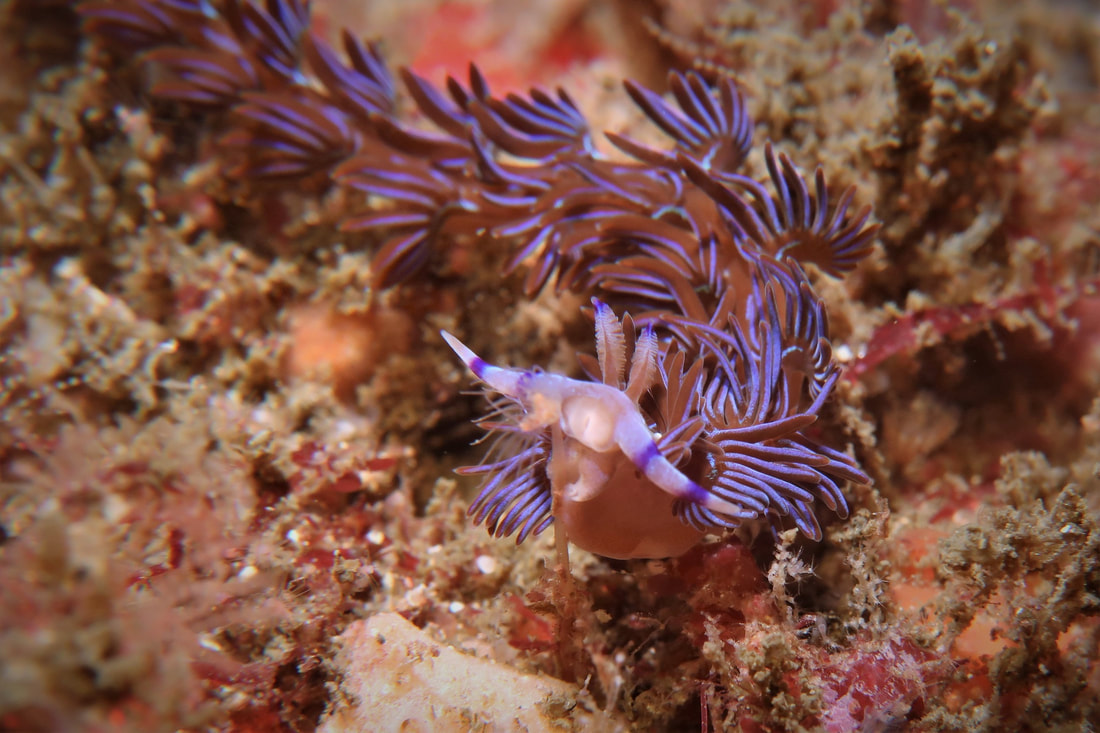
NUDI GILL PIN-UP: Costasiella Kuroshimae (AKA Sea Sheep)

November is a great time to practice gratitude. I am so grateful that Nudi Gill is now available for pre-order!

I am also grateful to you for reading my blog. Today I have a special guest. Everyone’s sweetheart…

Costasiella Kuroshimae
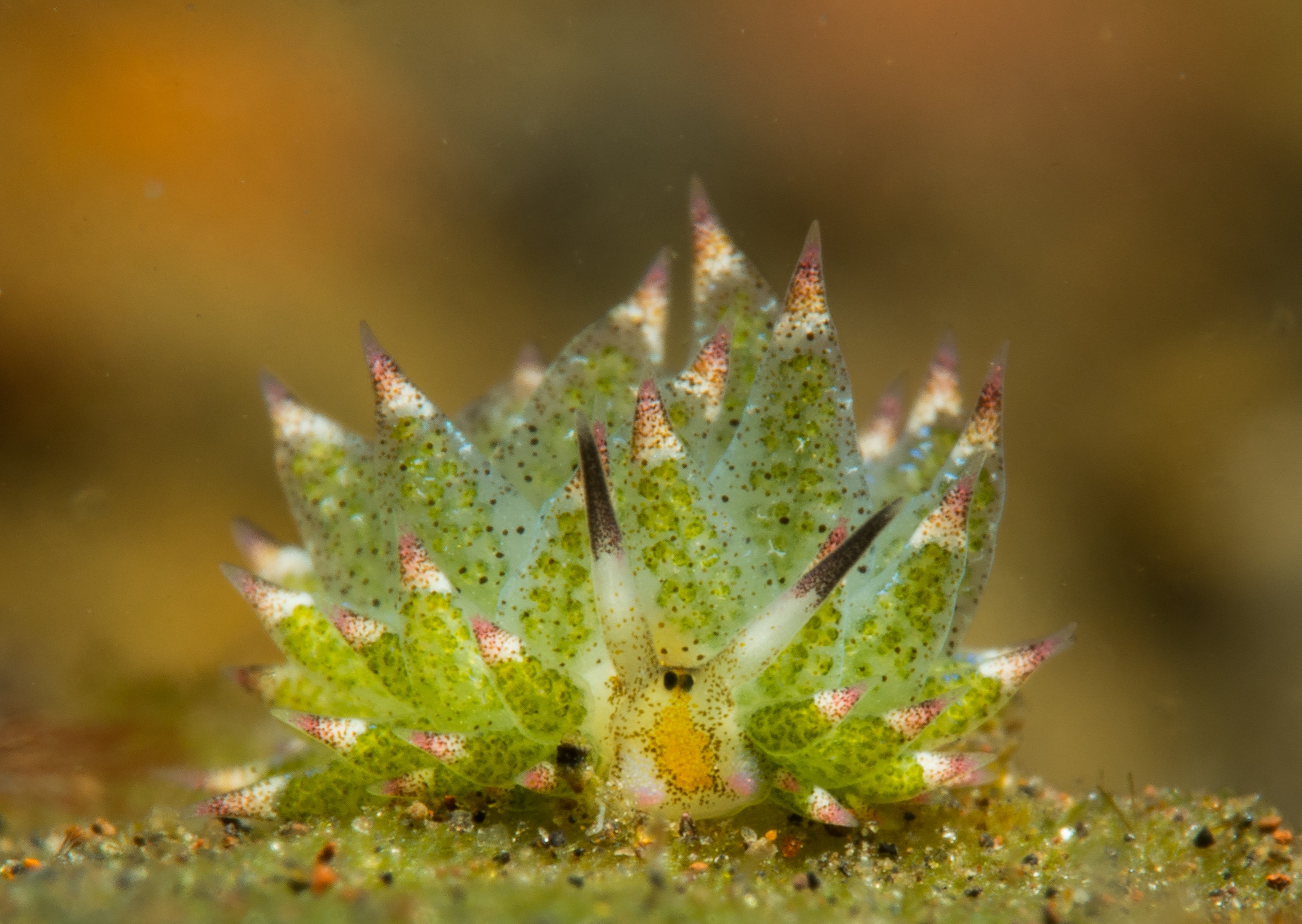
By alif_abdulrahman – Costasiella Kuroshimae, CC BY-SA 2.0, https://commons.wikimedia.org/w/index.php?curid=41894580

Costasiella Kuroshimae is not a nudibranch, but I felt like they had to be included in this series of pin-ups, because come on…. look at that face! The beloved Sea Sheep is in fact a sacoglossan sea slug. These little cuties are solar-powered and prefer a modest diet of algae. Here’s a little pop quiz for you:

In attempt to keep you from seeing the answer, I will bombard the page temporarily with adorable images of Sea Sheep.
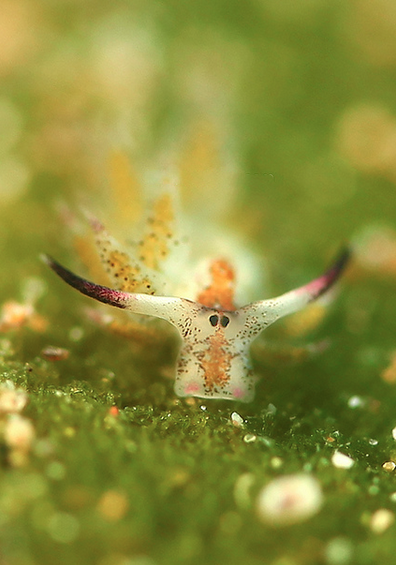
By Jun V Lao – Own work, CC BY-SA 4.0, https://commons.wikimedia.org/w/index.php?curid=52923406

Take a look at some Sea Sheep in action:


READY FOR THE ANSWER?

Actually, algae is neither plant nor animal. It falls into its own category called protists. Likewise, the Sea Sheep falls into its own category of cuteness.
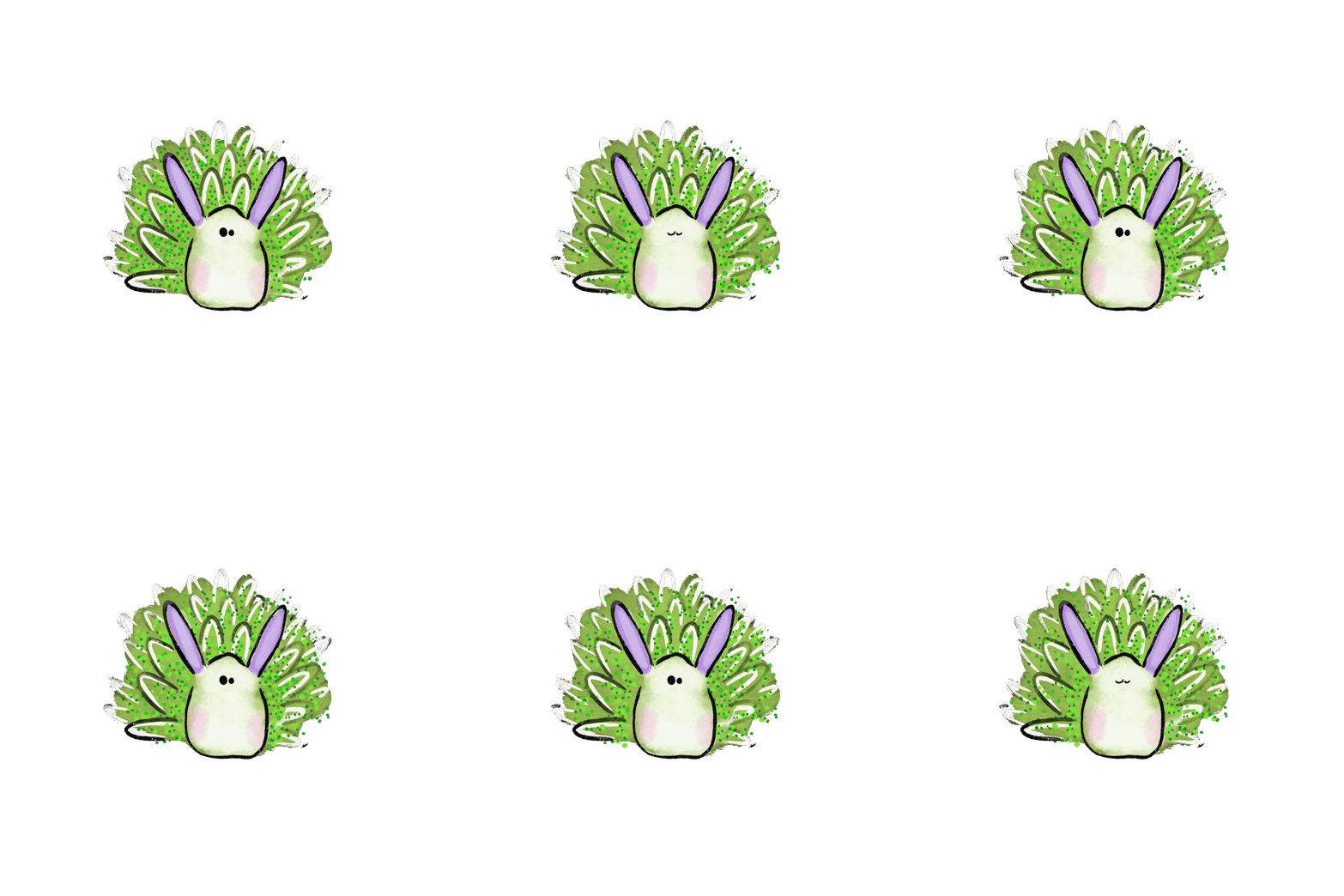
BAAAAAAAA!

These vitamin-sized cuties are small. They range from 5mm to 1cm in length. They are kleptoplastic which means that they feed on algae and can store the algae’s chloroplasts in their cells. This is how they are able to photosynthesize energy and nutrients from sunlight.

They were originally discovered in Japan. Their scientific name Kuroshimae refers to Kuroshima, Japan. It is a small southern island not too far from Taiwan. Since then, Sea Sheep have been found in other locations, including Indonesia, New Caledonia, Papua New Guinea, Northern Australia, and Singapore.

HEY, Next time you have trouble sleeping…

try counting Sea Sheep!

I hope you enjoyed oohing and awwwing over November’s sheepy sweetie of a supermodel pin-up, Costasiella Kuroshima. Stay tuned for December’s festive pin-up. You won’t want to miss it!

Gratefully yours,
Bonnie

NOW Available for pre-order!


Bonnie Kelso writes and illustrates books for children and adults that encourage individualism and brave self-expression. She facilitates art workshops for her local community and beyond. Her debut picture book, NUDI GILL, releases in March, 2023. A lover of nature and travel, she often wanders about outside with her family whenever an excellent opportunity to do so presents itself.

NUDI GILL BOOK TRAILER

Guess what today is?

It’s National Nudibranch Day!

What better day than to launch the book trailer for Nudi Gill: Poison Powerhouse of the Sea!

It’s also my birthday month, so I’m super excited to share October with National Nudibranch Day. So why is October 29th National Nudibranch Day? Well, this is also the birthday of Dr. Terry Gosliner, a biologist at the California Academy of Sciences and one of the world’s experts on nudibranchs. So spread the word and hug a sea slug today, because they’re awesome and so are you. (Just kidding about hugging a sea slug. Please don’t touch one, but I’m not kidding about you. You are definitely awesome.)

Now let’s take a look at this book trailer I mentioned earlier. I’ve never made a book trailer before, but discovered it is a lot of fun. In fact, I plan to make a whole lot more of them. So I hope you enjoy it and please give it a thumbs up!

Nudi Gill is now available for pre-order!

Wishing you a very happy National Nudibranch Day! Air hugs!!!

Bonnie

NOW Available for pre-order!


Bonnie Kelso writes and illustrates books for children and adults that encourage individualism and brave self-expression. She facilitates art workshops for her local community and beyond. Her debut picture book, NUDI GILL, releases March 7, 2023. A lover of nature and travel, she often wanders about outside with her family whenever an excellent opportunity to do so presents itself.

NUDI GILL PIN-UP: Cyerce Elegans

Happy September! I have exciting news to share… Nudi Gill is now available for pre-order!

Now that that is out of the way… let’s bring our attention back to the pin-ups, shall we? Today I have a sea slug species to share with you who is not a nudibranch. They may look like a jellyfish, an egg case, or spawn of the blob, but they are actually a living creature! Look closely for those telltale rhinophores to let you know who you are really dealing with.

Cyerce Elegans!

They are little, lacy, and 100% Loveable!

Nhobgood Nick Hobgood, CC BY-SA 3.0 https://creativecommons.org/licenses/by-sa/3.0, via Wikimedia Commons

Also known as the Butterfly Cyerce, the Cyerce Elegans is a species of sacoglossan sea slug meaning it is solar-powered and feeds primarily on algae unlike those carnivorous nudibranchs. Their leaf-like creata can be cast away if they feel threatened, providing for a distraction while they make their escape. They are relatives of the Cyerce Nigricans sea slug which resembles a tiny aquatic stegosaurus (which, by the way, is the best of all the dinosaurs).

Cyerce Nigricans. Katharina Händeler, Yvonne P. Grzymbowski, Patrick J. Krug & Heike Wägele, CC BY 2.0 https://creativecommons.org/licenses/by/2.0, via Wikimedia Commons

Here’s some beautiful footage of a Cyerce elegans on the move.

Those are some pretty sassy Salsa moves, Cyerces elegans!

I hope you enjoyed learning about September’s sassy supermodel pin-up, Cyerce elegans. Stay tuned for October’s loveable pin-up. You won’t want to miss this one!

May you display some sea slug elegans of your own today.

Bonnie

NOW Available for pre-order!


Bonnie Kelso writes and illustrates books for children and adults that encourage individualism and brave self-expression. She facilitates art workshops for her local community and beyond. Her debut picture book, NUDI GILL, releases in March, 2023. A lover of nature and travel, she often wanders about outside with her family whenever an excellent opportunity to do so presents itself.

NUDI GILL PIN-UP: Thecacera pacifica

Summer is winding down and kids are heading back to school, but that won’t stop me from sharing August’s awesome Nudi Gill Pin-up with you! With its bright yellow coloring and black-tipped rhinophores this nudibranch looks very much like a certain beloved Pokémon character. That’s right, it’s…

Thecacera pacifica!

AKA the Pikachu Nudibranch!

This nudibranch has some funky earlobed rhinophores! Their gills are also located a bit closer to the head than other species with two large papillae on either side. But just like other nudibranchs, they can deliver a nasty sting when threatened. Kind of like Pikachu and his electric shocks.

NUDI – NUDI – CHUUUUUU!

Here’s a great video that shows a bit more about the science behind a nudibranch’s stinging abilities. They literally steal stingers (or underdeveloped nemotocycts) from their food and hoard them in their cerata until matured and ready to fire off.

For a deeper dive (pun intended) on additional nudibranchs that resemble Pokémon characters, check out this fun video:

I know they’re adorable, but watch out!

IRL, They’re not as cute as they look!

A bolt of brilliance! I hope you enjoyed learning about August’s awesome NUDI GILL PIN-UP, Thecacera pacifica, aka the Pikachu nudibranch. Stay tuned for September’s sassy supermodel.

As always, I choose you!

Bonnie


Bonnie Kelso writes and illustrates books for children and adults that encourage individualism and brave self-expression. She facilitates art workshops for her local community and beyond. Her debut picture book, NUDI GILL, releases in March, 2023. A lover of nature and travel, she often wanders about outside with her family whenever an excellent opportunity to do so presents itself.

NUDI GILL PIN-UP: Spanish Shawl

With July coming to a close, I thought I’d share some thoughts about this colorful firework of the sea, the Flabellinopsis iodinea nudibranch! I know that’s quite a mouthful of vowels. I guess that’s why a lot of people call this little creature the Spanish Shawl instead.

Flabellinopsis iodinea

Jerry Kirkhart from Los Osos, Calif.

Oooooooh! Ahhhhhhh!

The Spanish Shawl is a species of aeolid nudibranch. I know, I know, more vowels. The aeolid suborder of nudibranch is the second largest next to the dorid nudibranchs. They typically have long tapered bodies, long cephala tentacles on their heads that are distinctly separate from their rhinophores, and clusters of creata respiratory organs that run along their back. Those are the bright orange bits on the photo above.

All these fancy body parts are not only beautiful, but functional as well. Let’s start with those cerata! They do double duty as respiratory system and digestive system. Can you imagine your lungs and stomach in one place? The cerata extract oxygen from the sea water, but they also store stinging cells absorbed through the sea sponges they eat. If a predator tries to eat the nudibranch, the cerata will release the harvested poison within.

Taken in Scripps Canyon, La Jolla, California by Magnus Kjærgaard Category:Opisthobranchia

The nudibranch’s rhinophores sense smell and vibrations in the water. These sensory organs are connected directly to the nudibranch’s brain. The long cephala tentacles are used in a tactile way, feeling around the nudibranch’s environment for food. They wave them ahead as they move forward. This is especially helpful, because a nudibranch has very poor eyesight.

Check out this neat video of Flabellinopsis iodinea in action. They even do a bit of free swimming at the end!

What a Face!


I hope you enjoyed learning about July’s explosively colorful NUDI GILL PIN-UP, Flabellinopsis iodinea, aka the Spanish Shawl. Stay tuned for August’s amazing supermodel.

I vowel to make it worth your time.

Bonnie


Bonnie Kelso writes and illustrates books for children and adults that encourage individualism and brave self-expression. She facilitates art workshops for her local community and beyond. Her debut picture book, NUDI GILL, releases in March, 2023. A lover of nature and travel, she often wanders about outside with her family whenever an excellent opportunity to do so presents itself.
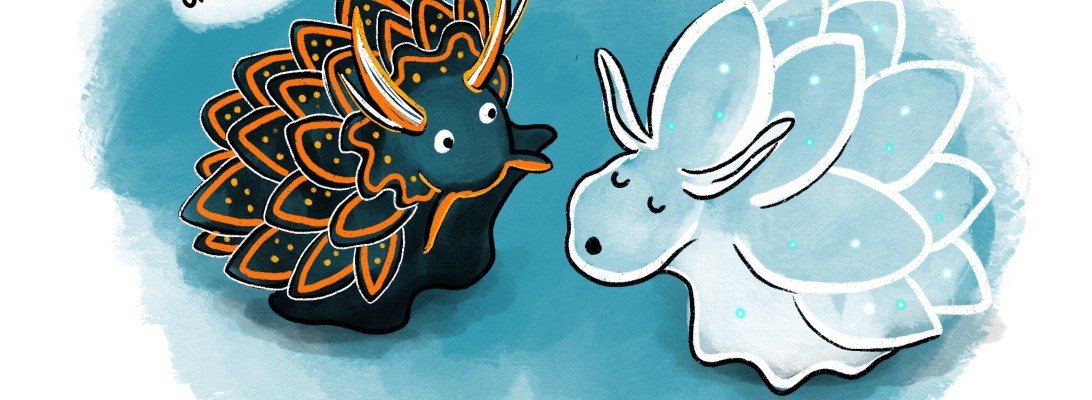
NUDI GILL PIN-UP: Sea Clown

In preparation for NUDI GILL, my debut picture book release in September 2022, I will be blogging about nudibranchs monthly. My hope is that you, too, will fall in love with these colorful little critters. Without further ado, allow me to introduce you to September’s supermodel:

Triopha Catalinae

Photograph by Minette Layne from Seattle, Washington, USA – Salome

Check out that mustache! Unlike other dorid nudibranchs, the sea clown’s dorsal gills are not fully retractable. Triopha Catalinae is comfortable letting it all hang out!

Spotted Triopha, or Triopha maculata, photographed in Morro Bay, California by Robin Agarwal. Sourced from Flickr and shared via Creative Commons License.

The Sea clown also comes in opposite coloration. Which is your favorite? I can’t decide, but I’m loving these fall colors. Makes me crave a pumpkin latte.

Photograph by divindk
Santa Barbara, USA
. Sourced from Flickr and shared via Creative Commons License.

No clowning around, these nudibranchs are small. How many sea clowns could pile into a clown car? Probably all of them!

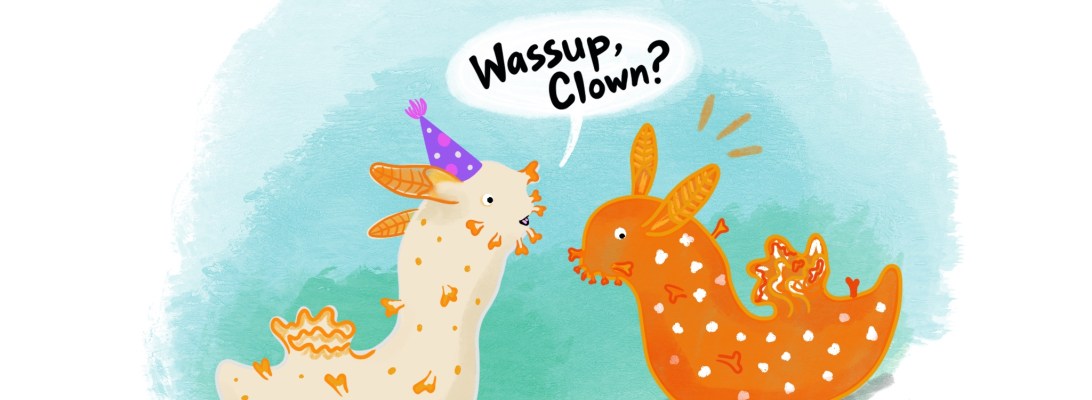
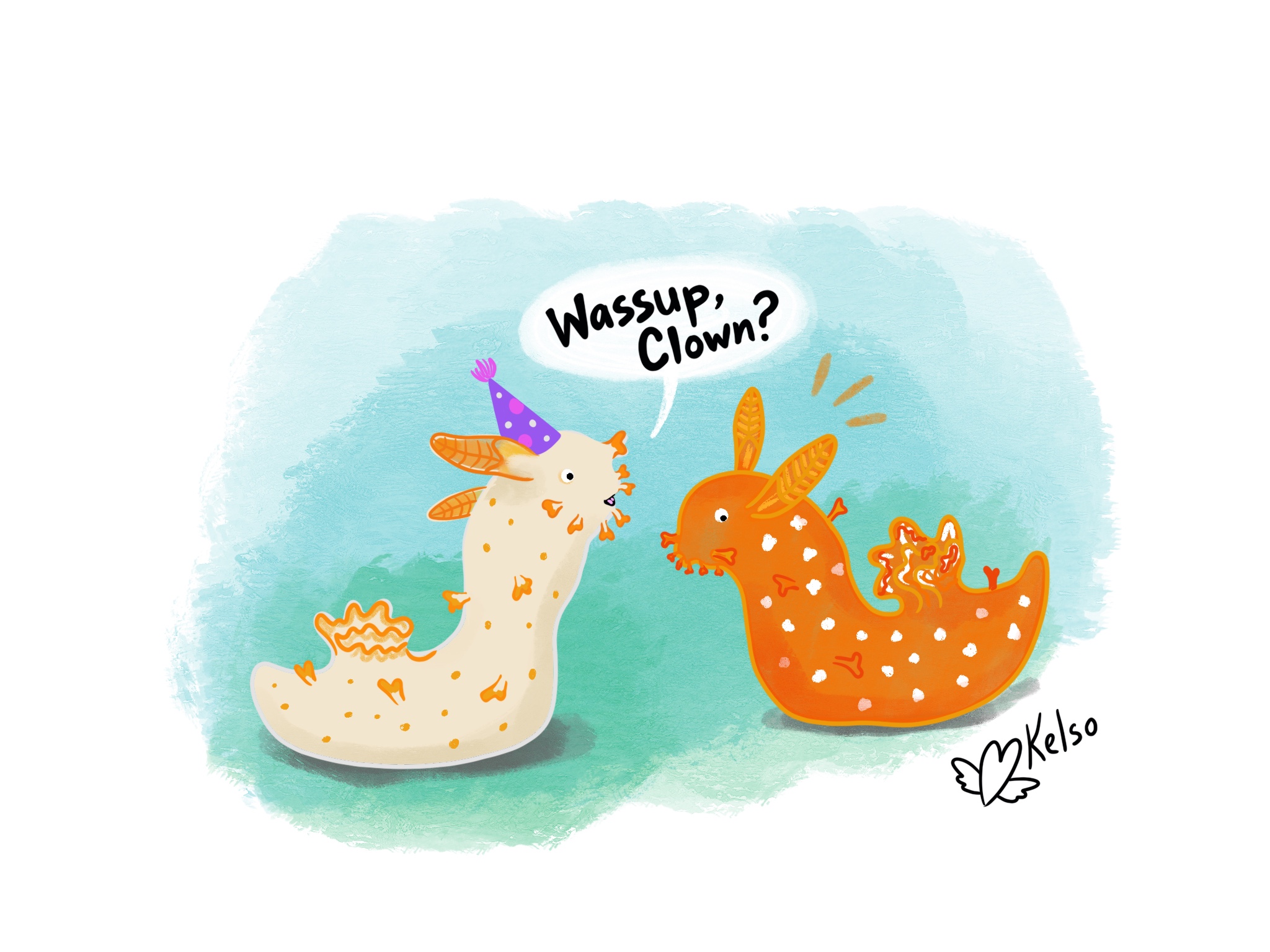
Who are you calling a clown?

The sea clown’s scientific name is derived from Santa Catalina Island, California, but you can find these nudibranchs in the Western Pacific from Mexico all the way to Alaska. They have also been found in costal areas of Japan and South Korea.

I hope you enjoyed meeting the Triopha Catalinae nudibranch. Stay tuned for October’s NUDI GILL Pin-Up!

Bonnie

Bonnie Kelso writes and illustrates books for children and adults that encourage individualism and brave self-expression. She facilitates art workshops for her local community and beyond. Her debut picture book, NUDI GILL, will be released in September, 2022. A lover of nature and travel, she can be found wandering about outside with her family whenever a good opportunity to do so presents itself.
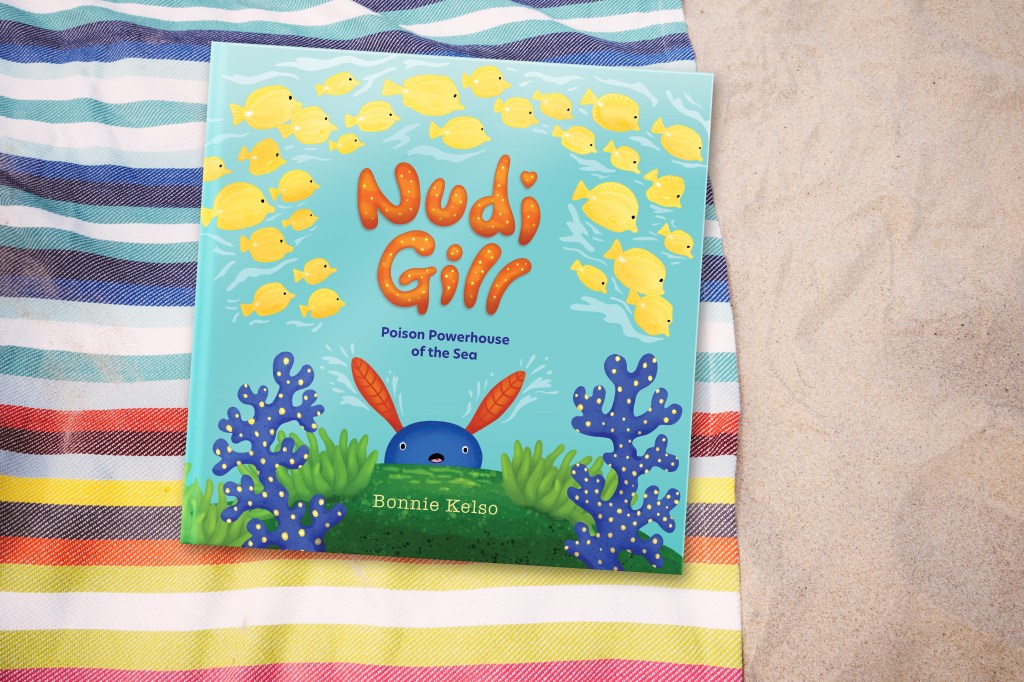
NUDI GILL PIN-UP: Pteraeolidia Ianthina

In preparation for NUDI GILL, my debut picture book release in September 2022, I will be blogging about nudibranchs monthly. My hope is that you, too, will fall in love with these colorful little critters. Without further ado, allow me to introduce you to August’s supermodel:

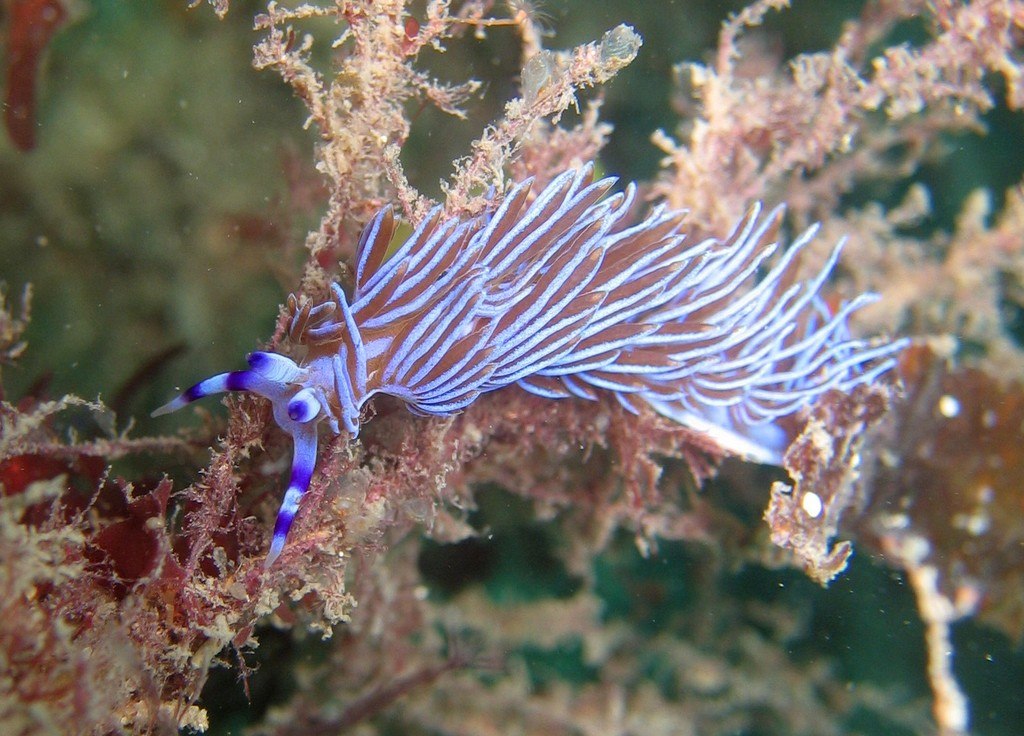
Pteraeolidia Ianthina

A Serpent Pteraeolidia (Pteraeolidia ianthina). Halifax Point, Port Stephens, NSW. Photograph by Richard Ling.

A long serpentine body covered in blue, purple, green, or brown cerata (respiratory organs), earned this nudibranch the nickname of blue dragon. Its long winding body is reminiscent of a Chinese Dragon. So cool. Check out this mug. What a face!

Photograph by Sarah Han-de-Beaux. You have GOT to check out her website and amazing photographs, really!

What I find most astonishing about Pteraeolidia Ianthina is that is it solar-powered. Tesla has nothing on this baby! This nudibranch has developed a method of capturing and farming microscopic plants (known as zooxanthellae) right inside its own body. It’s a win-win relationship because the nudibranch provides protection for the plants and the plants help feed the nudibranch with the sugars they convert from the sun’s energy. (Read more about this on The Sea Slug Forum.)

The more zooxanthellae, the greener the nudibranch appears.

Talk about going green!

You can find these fiercely fabulous nudibranchs throughout the Indo-Pacific.

I hope you enjoyed meeting the Pteraeolidia Ianthina Nudibranch. Stay tuned for September’s NUDI GILL Pin-Up!

Bonnie

Bonnie Kelso writes and illustrates books for children and adults that encourage individualism and brave self-expression. She facilitates art workshops for her local community and beyond. Her debut picture book, NUDI GILL, will be released in September, 2022. A lover of nature and travel, she can be found wandering about outside with her family whenever a good opportunity to do so presents itself.